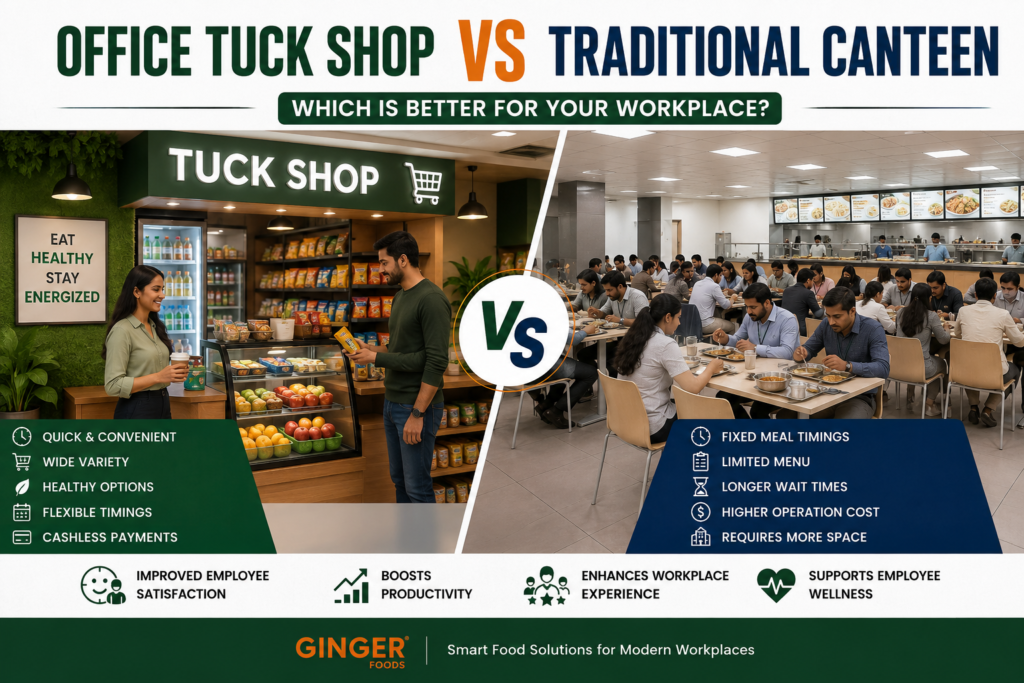
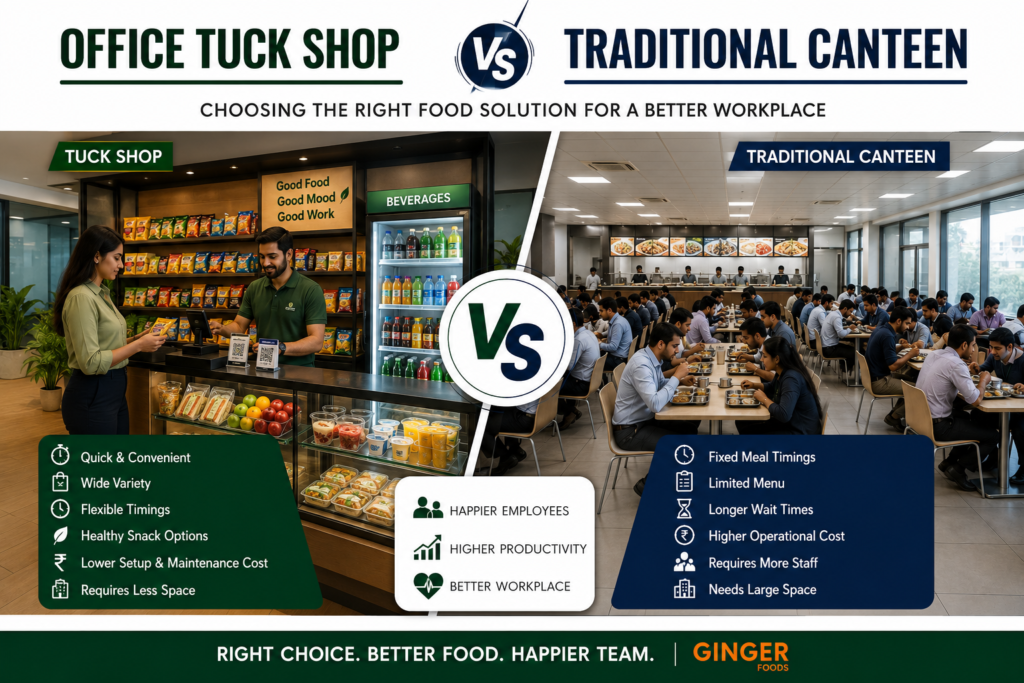
n today’s corporate environment, companies are rethinking how they provide food and refreshment facilities to employees. While traditional office canteens have been a standard workplace feature for decades, modern businesses are increasingly adopting office tuck shops as a more flexible and employee-friendly alternative.
The big question for HR managers, facility teams, and business owners is:
Should you choose a traditional canteen or an office tuck shop?
The answer depends on your office size, workforce behavior, budget, and workplace culture. In this detailed guide, we compare both models across cost, convenience, productivity, space requirements, food variety, and employee satisfaction to help you make the right decision.
What is a Traditional Office Canteen?
A traditional canteen is a large-scale food facility that prepares and serves complete meals such as breakfast, lunch, dinner, and beverages to employees. It usually includes a kitchen, dining area, cooking staff, and fixed meal timings.
Common Features
- Full meal preparation
- Dedicated kitchen infrastructure
- Seating and dining space
- Fixed menu
- Scheduled serving hours
- Higher operational management
Traditional canteens are commonly found in factories, manufacturing plants, government offices, hospitals, and large corporate campuses.
What is an Office Tuck Shop?
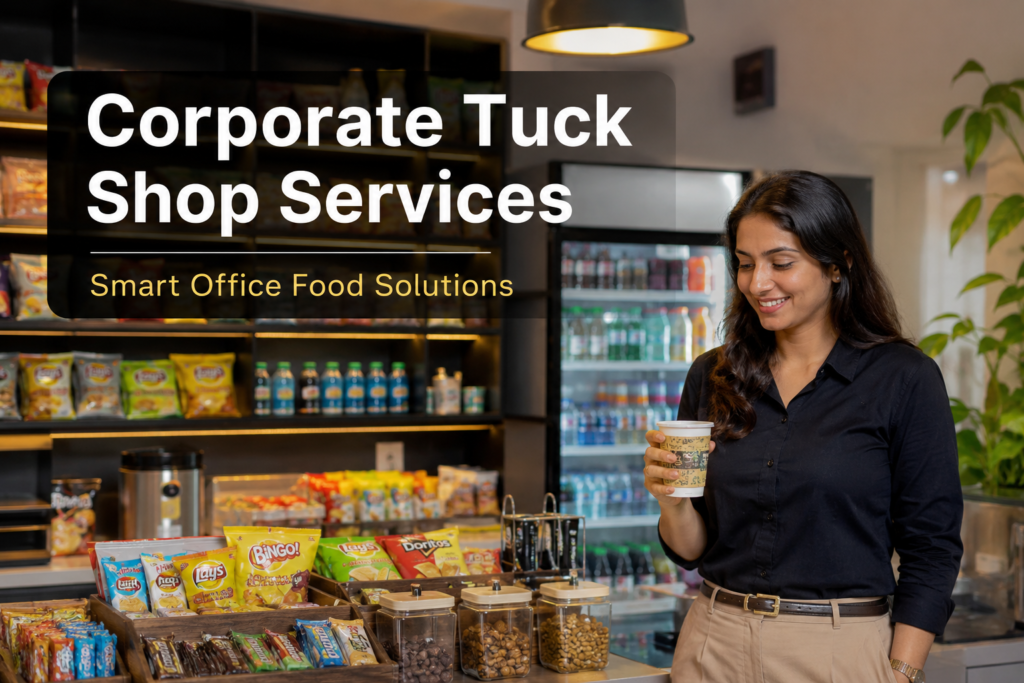
An office tuck shop is a compact food and refreshment outlet located within the workplace. It focuses on quick-service snacks, beverages, healthy bites, sandwiches, wraps, ready-to-eat meals, and daily essentials rather than large-scale meal preparation.
Common Features
- Minimal setup
- Quick grab-and-go service
- Digital payments
- Flexible inventory
- Healthy snack options
- Lower staffing requirements
Tuck shops are especially popular in IT offices, startups, coworking spaces, BPOs, and modern corporate environments.
Quick Comparison Table
| Feature | Office Tuck Shop | Traditional Canteen |
|---|---|---|
| Setup Cost | Low | High |
| Space Requirement | Small | Large |
| Meal Preparation | Limited | Full Kitchen |
| Service Speed | Very Fast | Moderate |
| Employee Convenience | High | Medium |
| Food Variety | Flexible | Fixed Menu |
| Staffing Requirement | Low | High |
| Maintenance Cost | Low | High |
| Best For | Offices, IT, Startups | Factories, Large Campuses |
Cost Comparison
Tuck Shop: Budget-Friendly
A tuck shop requires:
- Display counters
- Refrigerator
- Microwave
- Coffee machine
- Billing system
- Basic storage
There is no need for a large kitchen, heavy cooking equipment, exhaust systems, or extensive dining infrastructure.
Result:
Lower initial investment and lower monthly operational costs.
Traditional Canteen: High Investment
A canteen typically requires:
- Commercial kitchen
- Cooking equipment
- Gas pipeline
- Exhaust system
- Dining furniture
- Kitchen staff
- Cleaning team
- Utility management
Result:
Significantly higher capital and operational expenses.
Winner: Office Tuck Shop
Space Utilization
Modern offices often operate in premium commercial spaces where every square foot matters.
Tuck Shop Advantage
A functional tuck shop can operate within 100–250 sq. ft., making it ideal for:
- IT offices
- Startup hubs
- Shared workspaces
- Compact corporate floors
Canteen Limitation
A traditional canteen requires:
- Kitchen area
- Storage room
- Washing area
- Dining space
- Utility zone
This can easily consume 1,000+ sq. ft. in a medium-sized office.
Winner: Office Tuck Shop
Employee Convenience
Why Employees Prefer Tuck Shops
Employees today prefer speed and flexibility.
They can:
- Grab coffee between meetings
- Buy a sandwich during a 10-minute break
- Purchase healthy snacks without leaving the office
- Avoid waiting in meal queues
This aligns with the fast-paced nature of modern workplaces.
Canteen Challenges
Traditional canteens often involve:
- Fixed meal timings
- Queue management
- Crowded lunch hours
- Limited availability outside serving hours
For employees working in shifts or flexible schedules, this can be inconvenient.
Winner: Office Tuck Shop
Productivity Impact
Tuck Shop = Less Time Away from Work
When refreshments are available nearby, employees spend less time:
- Walking outside
- Waiting for food
- Searching for nearby cafes
Shorter break durations can lead to better time management and improved productivity.
Canteen = Longer Break Cycles
Large canteens encourage full meal breaks, which are important but may also extend downtime, especially during peak lunch hours.
Winner: Office Tuck Shop
Food Variety and Flexibility
Tuck Shop Flexibility
Inventory can be updated quickly based on employee preferences.
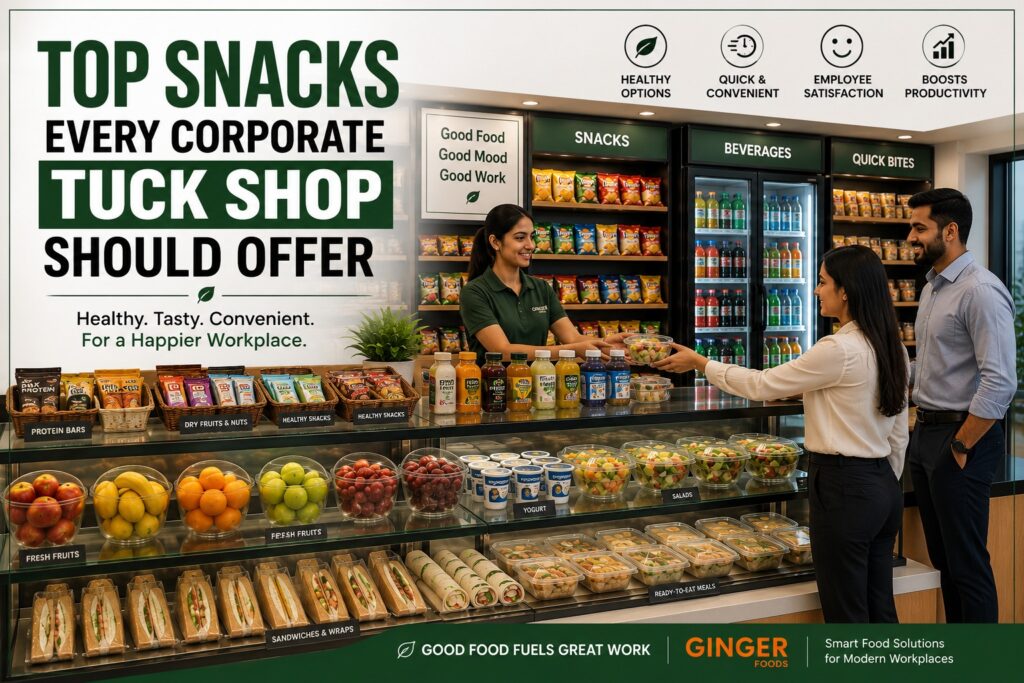
Popular Additions
- Protein bars
- Fresh fruits
- Greek yogurt
- Cold coffee
- Smoothies
- Wraps
- Salad bowls
- Gluten-free snacks
- Vegan options
This makes tuck shops highly adaptable to changing food trends.
Canteen Menu Constraints
Canteens usually operate on a pre-planned weekly menu. Changing dishes frequently can increase procurement complexity and food wastage.
Winner: Office Tuck Shop
Hygiene and Food Safety
Both models can maintain excellent hygiene if managed professionally.
Tuck Shop Advantage
Since food preparation is limited, there are fewer contamination points and easier inventory monitoring.
Canteen Advantage
A professionally managed canteen can provide freshly cooked meals under strict food safety standards.
Winner: Tie (depends on management quality)
Which is Better for Different Office Types?
Best Choice by Workplace
IT Companies
Best: Office Tuck Shop
Startups
Best: Office Tuck Shop
BPO / Call Centers
Best: Office Tuck Shop
Coworking Spaces
Best: Office Tuck Shop
Manufacturing Plants
Best: Traditional Canteen
Industrial Units
Best: Traditional Canteen
Large Corporate Campuses (5,000+ employees)
Best: Hybrid Model
The Hybrid Model: The Smartest Solution
Many successful organizations now combine both facilities.
Traditional Canteen Provides
- Breakfast
- Lunch
- Dinner
- Subsidized meals
Tuck Shop Provides
- Coffee
- Evening snacks
- Healthy bites
- Late-shift refreshments
- Grab-and-go options
This approach offers the best balance of nutrition, convenience, and operational efficiency.
Why Companies Are Shifting Toward Tuck Shops in 2026
Several workplace trends are accelerating this shift:
- Hybrid work culture
- Flexible office attendance
- Smaller office footprints
- Demand for healthy snacks
- Cashless payment adoption
- Focus on employee experience
- Reduced infrastructure costs
For many businesses, investing in a large canteen no longer makes economic sense when daily occupancy fluctuates.
How Ginger Foods Helps Corporate Offices
At Ginger Foods, we provide customized workplace food solutions designed for modern businesses.
Our Services
- Corporate Tuck Shop Setup
- Office Cafeteria Management
- Healthy Snack Counters
- Tea & Coffee Stations
- Corporate Catering
- Packed Lunch Solutions
- Employee Wellness Food Programs
We help organizations create food facilities that improve employee satisfaction while optimizing operational costs.
Final Verdict: Which is Better?
Choose an Office Tuck Shop if:
- You have 50–1,500 employees
- Office space is limited
- Employees need quick refreshments
- You want lower setup costs
- Your workforce follows flexible schedules
- Employee experience is a priority
Choose a Traditional Canteen if:
- You have a large industrial workforce
- Employees require full daily meals
- Shift operations run 24/7
- Subsidized meal programs are essential
- You have sufficient space and budget
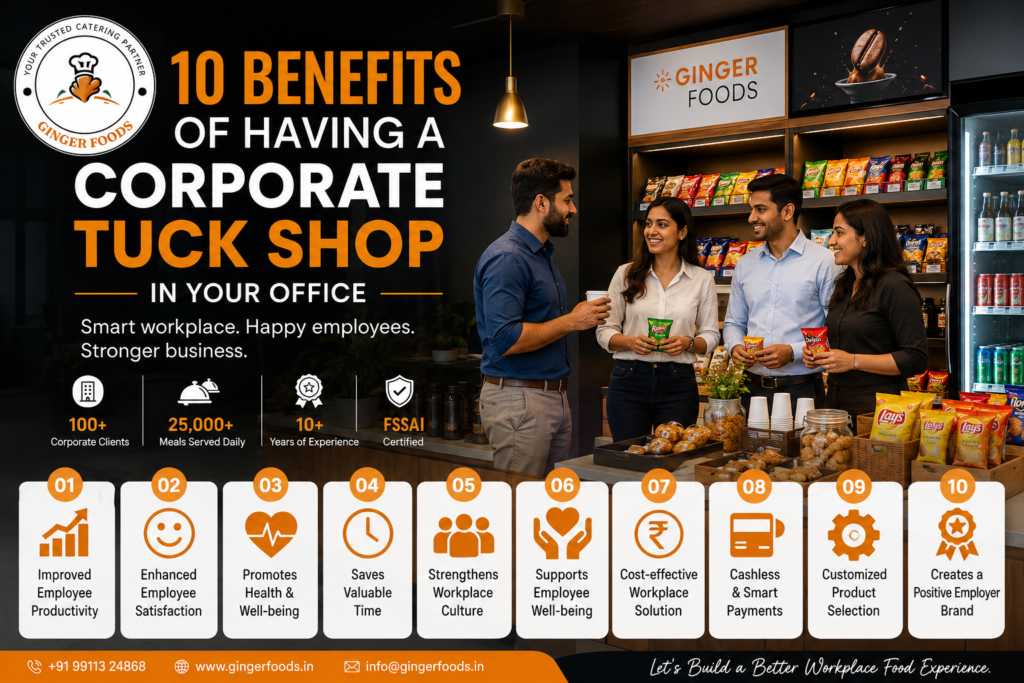
For most modern corporate offices, IT companies, startups, and commercial workplaces, the Office Tuck Shop is generally the better choice because it offers higher convenience, lower operational costs, better space efficiency, and stronger alignment with today’s employee expectations.
However, the ideal solution is not always one or the other. A hybrid model—combining a cafeteria for main meals and a tuck shop for quick refreshments—often delivers the best employee experience and long-term value.
FAQs
Is a tuck shop cheaper than a canteen?
Yes. A tuck shop typically has lower setup, staffing, and maintenance costs because it does not require a full commercial kitchen.
Can a tuck shop replace an office canteen completely?
For many IT offices, startups, and medium-sized corporate workplaces, yes. For large industrial facilities, a canteen is usually still necessary for full meal service.
What products should a corporate tuck shop offer?
Healthy snacks, sandwiches, wraps, fruits, yogurt, beverages, coffee, tea, protein bars, and ready-to-eat meals.
How does a tuck shop improve productivity?
Employees spend less time leaving the office for refreshments, which reduces extended breaks and helps maintain workflow continuity.
Does Ginger Foods provide tuck shop setup services?
Yes. Ginger Foods offers end-to-end corporate tuck shop setup, cafeteria management, catering, and employee food solutions tailored to workplace requirements.